

 English
 日本語
 Deutsch


Industry News
 Oct 23, 2026
 Posted by Administrator
What Are the Benefits of CNC Machined Aluminum Alloy Components, and When Does a Hybrid Process Make More Sense?
Why Engineers Are Rethinking Aluminum Machining
Aluminum alloy has become the default material for precision mechanical, automotive, electronics and industrial parts. It combines light weight, good thermal conductivity, corrosion resistance and a machinability that few metals can match. Yet the real question for most buyers is not whether to use aluminum, but how to make the part. Die casting, full CNC machining and cold extrusion followed by secondary CNC work each offer a different balance of cost, precision and strength, and choosing the wrong route can add weeks to a project or add unnecessary cost to every unit.
This guide looks at the benefits of cnc machined aluminum alloy components, the situations where pure machining is the right call, and the point where a hybrid route built on cold forming and CNC finishing creates a stronger business case. The goal is practical: give design engineers and sourcing teams a framework they can apply to the next drawing that lands on their desk.
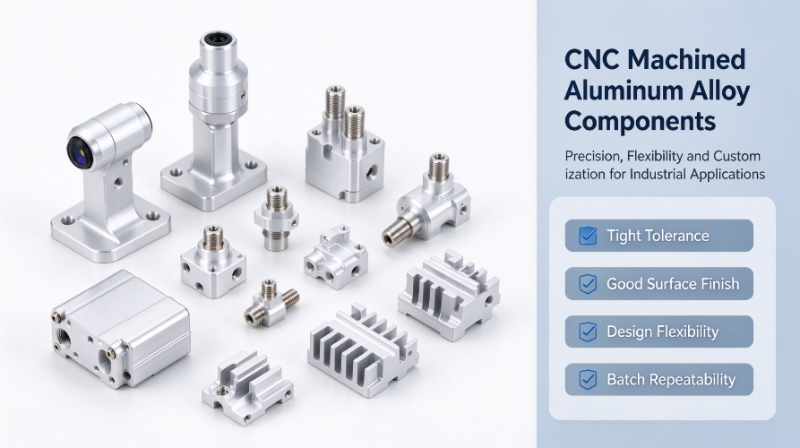
Image source: AI-generated for illustration purposes only.
Key takeaway: pure CNC machining wins on flexibility and tight tolerance, while a hybrid process wins when volume grows and the part keeps a relatively simple main body.
What Defines CNC Machined Aluminum Alloy Components
CNC machined aluminum alloy components are parts cut from solid bar, plate or pre-formed stock using computer-controlled milling, turning, drilling and tapping equipment. The program defines every toolpath, so one set of drawings can become a finished part without tooling built specifically for that geometry. This is why the process is so widely used for custom CNC aluminum precision parts, especially when designs are still evolving.
Common Aluminum Grades
Grade selection controls strength, machinability and finishing options. The grades below cover most requests for machined parts.
| Alloy | Strength Character | Machinability | Typical Use |
|---|---|---|---|
| 6061 | Good strength, weldable | Very good | Frames, brackets, housings |
| 6063 | Moderate strength, smooth finish | Good | Visible enclosures, heat sinks |
| 7075 | High strength | Good | Structural and high-load parts |
| 2024 | High fatigue resistance | Fair | Fatigue-loaded fittings |
Typical Part Forms
Machined aluminum is used for a broad range of geometries. The most common include:
- Housings and covers that protect electronics or sensors
- Brackets and mounting plates for automotive and automation systems
- Connectors, adapters and fluid fittings with precise sealing faces
- Heat sinks with fine fin geometry and flat contact surfaces
- Sensor structures that must keep critical datums within tight limits
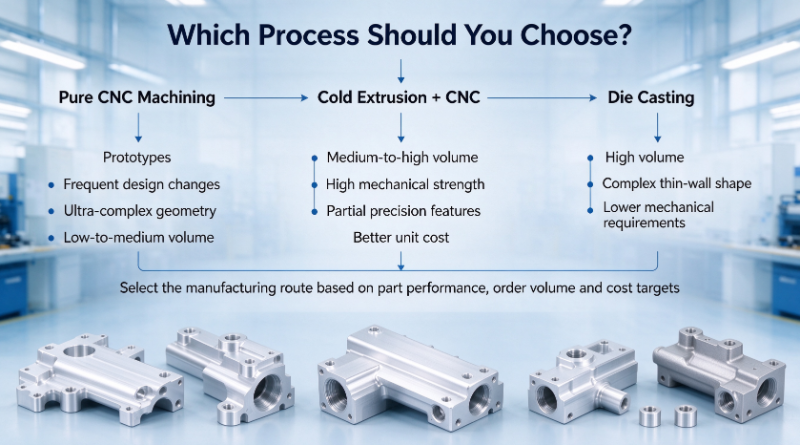
Image source: AI-generated for illustration purposes only.
Core Benefits of CNC Machined Aluminum Alloy Components
The advantages of machining aluminum are not limited to one feature. They show up across accuracy, finish, material quality, design flexibility and batch consistency. Each benefit matters differently depending on the project stage and the volume.
Dimensional Accuracy and Tight Tolerance
Modern three-axis and five-axis machining centers routinely hold critical features to about 0.01 mm. Short, stable dimensions can go tighter when fixturing and temperature are well controlled. Because the cutting path is software-defined, deep pockets, thin walls and complex contours can be produced without the draft angles or parting lines that constrain molded or cast alternatives.
Surface Finish and Post-Treatment Flexibility
Machined aluminum accepts a wide range of finishes. Anodizing adds corrosion resistance and surface hardness, sandblasting gives a uniform matte look, powder coating provides color and wear protection, and chemical passivation keeps surfaces suitable where conductivity matters. A clean machined surface usually needs less rework before anodizing, which helps keep color and appearance consistent across a batch.
Material Integrity Without Casting Defects
Because the part is cut from wrought stock, it does not carry the porosity, shrinkage cavities or gas pockets that can form during solidification. This matters for pressure housings, fluid manifolds and fatigue-loaded brackets. Wrought material also offers a predictable grain structure, which simplifies strength verification and reduces the risk of leaks discovered late in testing.
Design Freedom for Prototypes and Low Volumes
Changing a machined part means editing a program rather than reworking a steel mold. A prototype run can move from drawing to finished samples in days, while tooling development for casting or forming often takes many weeks and a significant upfront investment. For products still in validation, this speed lets engineering teams test several geometries before committing to a production route.
Repeatability for Small and Medium Batches
With stable fixturing, documented programs and in-process inspection, machining delivers consistent results across batches of hundreds or a few thousand parts. Statistical monitoring of key dimensions catches tool wear early, so quality holds without the large fixed cost that high-volume processes require.
Where Pure CNC Machining Reaches Its Limits
Pure machining is not the answer to every aluminum part. Its main constraint is material efficiency. The process starts from a block larger than the finished part, and every portion of that block outside the final geometry becomes chips. On parts with heavy material removal, the ratio of purchased stock to finished part can be high, which pushes up both material cost and machine time.
- Material waste: a large share of purchased stock may end as chips on parts with deep, heavy removal
- Cycle time: roughing large volumes ties up CNC capacity and slows throughput
- Unit cost: at medium and high volumes, machining time per part rarely falls enough to offset the complexity-free geometry that could be formed more economically
The chart below shows illustrative ranges for how much of the purchased material typically ends up in the finished part under different routes. Actual values depend heavily on geometry.
Illustrative ranges for the share of purchased material that ends in the finished part.
Cold Extrusion Plus CNC: A Hybrid Approach
The hybrid route uses cold extrusion or cold forging to form a near-net shape. The main body, bosses and basic geometry are formed at room temperature under high pressure, which also compacts and aligns the grain structure. CNC machining then cuts only the features that need tight tolerance, such as bearing bores, sealing faces, threads and mounting datums. The finished part keeps the strength of formed metal while needing far less machining than a part cut entirely from bar. Many projects use aluminum cold forging as the first step for exactly this reason.
Advantages Over Pure CNC
- Lower raw material waste, which reduces unit cost for medium and high volumes
- Higher strength and a denser structure inherited from the cold forming step
- CNC time concentrated on the few surfaces that truly require it
Advantages Over Die Casting
Compared with die casting, cold formed aluminum avoids porosity and typically offers better fatigue performance. This makes it well suited to leak-proof housings and load-bearing brackets. Die casting remains a strong option for thin-wall, intricate geometry at very high volume, and the two routes are compared in more depth in a separate article on cold extrusion and die casting for aluminum.
The hybrid route makes the most sense when the main body is relatively simple, the part requires good mechanical strength, only a few features need precision machining, and annual volume is high enough to amortize the forming tooling.
Choosing the Right Process for Your Part
Process selection is easiest when you start from volume, geometry and tolerance distribution. The three routes below cover most aluminum projects.
Choose pure CNC machining when
The project is a prototype or a low-volume run, design changes are frequent, the geometry is highly complex, or tight tolerance is needed on nearly every surface.
Choose cold extrusion plus CNC when
The main body is relatively simple, only some features need precision machining, the part must carry significant mechanical load, and production volume justifies forming tooling.
Choose die casting when
Volume is very high, the part has thin walls and complex castable geometry, and the mechanical requirement is moderate rather than demanding.
Many disagreements about process come from unclear priorities. If the drawing demands tolerance everywhere, pure machining is usually the honest answer. If it demands strength plus precision on a small number of features, the hybrid route is often the most efficient.
Typical Applications for Custom CNC Aluminum Precision Parts
The following sectors rely heavily on machined aluminum because they combine precision, light weight and reliable surface treatment.
- Automotive sensor brackets and small structural components that must hold alignment under vibration
- Electronics and communication enclosures requiring accurate mounting and good heat spreading
- Automation equipment fittings, guides and motion interface parts
- Medical and instrumentation precision components where dimensional stability is critical
- Aerospace-related small non-critical aluminum parts such as brackets and covers
Practical Tips When Sourcing Machined Aluminum Components
A clear request for quotation saves time on both sides. The following checks help buyers and engineers avoid costly surprises.
- Confirm the aluminum alloy grade, tolerance requirements and inspection standards before quoting, since each affects cost and lead time.
- Clarify surface treatment and corrosion resistance requirements, including color, thickness and any conductivity limits after finishing.
- Communicate expected order volume early, so the supplier can recommend pure CNC or a cold extrusion plus CNC solution for a better balance of cost and lead time.
- Verify factory capability, including the number of CNC centers, the range of machining axes and the quality inspection equipment available.
- Request a first article inspection report for critical precision parts before approving mass production.
Conclusion
CNC machined aluminum alloy components offer unmatched precision and design flexibility, especially for prototypes, low volumes and parts with complex geometry. Their accuracy, finishing options and defect-free material make them a dependable choice for demanding applications.
For medium and high volumes with a simpler main body, a cold extrusion plus CNC hybrid route often delivers better strength, lower waste and a more competitive unit cost. The right choice depends on volume, geometry and where tight tolerance is truly needed. If you share your CAD drawings and expected volumes, a process review can clarify which route fits your project best and what a realistic quotation should look like.
Frequently Asked Questions
Q1: What tolerance can CNC aluminum parts achieve?
Typical production tolerance on critical features is around 0.01 mm. Short, stable dimensions can be held tighter in a controlled environment, while non-critical surfaces are usually specified looser to keep costs down.
Q2: Is CNC aluminum stronger than die cast aluminum?
In general, wrought material from bar or formed stock offers more uniform strength and better fatigue resistance than die cast material, because it does not contain porosity. Actual strength still depends on alloy and heat treatment, so compare specific grades and conditions.
Q3: What is the difference between CNC machining and cold extrusion for aluminum parts?
Cold extrusion shapes metal at room temperature by forcing it through a die, forming the main geometry with very little waste. CNC machining removes material to create the final shape and is best for precision features and lower volumes. Many projects use both in sequence.
Q4: Can you combine cold extrusion with CNC machining?
Yes. Cold extrusion creates a near-net shape, and CNC machining then finishes critical surfaces such as bores, sealing faces and threads. This combination reduces material waste and machining time while keeping precision where it is required.

-
Tel Number
+86-0572-2210226Phone Number
+86-13819283977 +86-13655726561 +86-13567228000Address
Building B, Innovation and Entrepreneurship Industrial Park, No. 288, Yansan Road, Huzhou City, Zhejiang Province, ChinaQrCode
-
Quick Links
Home Products About Us Capabilities Industries News Contact Us -
Explore
Aluminum Camera Shell Of Vehicle Aluminium Cold Extrusion Aluminium Cold Forging Parts -
feel free to contact us
