

 English
 日本語
 Deutsch


Industry News
 Oct 29, 2026
 Posted by Administrator
Anodizing or Powder Coating: How to Choose the Right Surface Treatment for Precision Aluminum Parts
Why Surface Treatment Decides How Precision Aluminum Parts Perform
Precision aluminum parts rarely fail because of the base alloy alone. In most field failures the surface layer is the weak point: a finish that peels under vibration, wears through at a sliding interface, or corrodes after a few months of salt spray or humid storage. For engineers and purchasing teams, the surface treatment is a core functional decision that shapes durability, electrical behavior, dimensional accuracy and total cost. It is not a cosmetic afterthought.
Two processes dominate the market for aluminum components used in automotive electronics, industrial robots and unmanned aerial vehicles: anodizing and powder coating. Both protect aluminum effectively, yet they work in fundamentally different ways. Anodizing grows an oxide layer from the metal itself, while powder coating bonds a polymer layer onto the surface. Choosing the wrong one can lead to premature wear, tolerance conflicts, blocked threads or an unexpected budget increase after samples have already been machined.
This guide compares both processes from a practical sourcing perspective. It explains how each one works, where each performs well, how the choice affects tight tolerances, what drives cost, and how to match the treatment to real operating conditions. The goal is to help you specify a finish for your aluminum parts from the first drawing revision rather than discovering problems during validation.
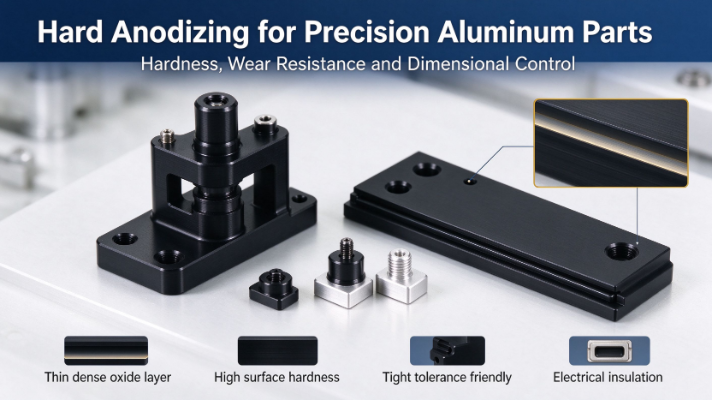
Quick answer: Anodizing is usually the better choice for tight-tolerance functional surfaces, electrical insulation and wear resistance. Powder coating is generally preferred for thick, uniform protection on outdoor-facing parts and for strong color and texture requirements.
How Aluminum Anodizing Works and Where It Fits
The electrochemical principle
Anodizing is an electrochemical process in which the aluminum part acts as the anode in an acid electrolyte bath. Under controlled current, voltage and temperature, oxygen combines with aluminum at the surface to form a porous aluminum oxide layer. This film is part of the base metal rather than a separate coating, so it does not peel in the conventional sense. The pores can then be sealed or filled with dye to achieve a wide range of colors and improved corrosion performance. Because the film is grown from the substrate, adhesion is excellent, and the process suits parts that must keep their edges, threads and machined geometry intact.
Common types for precision components
- Type II standard anodizing: A relatively thin film that offers good appearance, a broad dyeable color range and reliable corrosion protection. It is the usual choice for consumer-facing housings and general-purpose brackets.
- Type III hard anodizing: A thicker and denser film with high hardness, suited to sliding surfaces, guide features, actuator interfaces and parts exposed to repeated friction.
Strengths for precision aluminum components
- Excellent adhesion, because the film grows from the substrate instead of sitting on top of it.
- High surface hardness and wear resistance, especially with hard anodizing.
- Good corrosion resistance in most indoor and moderately aggressive environments.
- A thin film build that preserves tight dimensional tolerances when growth is properly compensated.
- Surface electrical insulation, which is useful for mounting features and grounding design.
- A metallic texture with a clean, consistent appearance on machined surfaces.
Limitations to plan around
- Dyed finishes can fade under prolonged UV exposure, so they are not ideal for long-term outdoor exterior use.
- Coverage can be uneven in deep cavities and sharp internal corners, where electrolyte flow is restricted.
- Color consistency becomes harder to control on complex geometries and mixed-alloy batches.
- The process cannot hide porosity, scratches or machining marks. It tends to reveal them.
Hard anodizing deserves a special note for precision work. The film grows partly into the original surface and partly outward, so dimensions change on both sides of the part. Drawings must account for this growth on critical diameters, threaded features and press-fit areas. Otherwise a correctly machined part can still fall outside tolerance once it is finished.
Powder Coating for Aluminum Parts: Process and Strengths
How the coating is built
Powder coating applies a dry, finely ground polymer powder to the aluminum surface using electrostatic charge, so the particles are attracted evenly to the grounded part. The coated part then enters a curing oven, where the powder melts, flows and chemically cross-links into a continuous film. Because no solvent evaporates during curing, the process produces low volatile emissions compared with many liquid coating systems. The result is a thick, uniform layer that hides small surface imperfections and provides strong barrier protection against moisture and salt.
Core advantages for aluminum components
- Superior corrosion resistance, particularly for outdoor and high-humidity service.
- A wide range of matte, gloss, textured and metallic-effect colors with uniform appearance.
- A thicker film that visually covers minor blemishes and light machining marks.
- Good impact resistance and resistance to chipping during handling.
- Low volatile emissions and a generally favorable environmental profile.
Limitations to consider
- The coating build is much thicker, which can push critical fits outside tolerance if it is not planned into the design.
- Orange peel, dust inclusions and edge build-up are more likely on sharp corners and complex profiles.
- Ultra-tight functional surfaces, such as sealing faces and precision bores, are usually masked or excluded.
- Surface hardness is lower than hard anodizing, so the coating is easier to scratch in sliding contact.
Side-by-Side Performance Comparison
The table below summarizes how the two processes behave across the properties that most often drive specification decisions. Ratings are relative and depend on the alloy, film specification, sealing quality and resin system, so they should be confirmed against your own test requirements.
| Property | Anodizing | Powder Coating |
|---|---|---|
| Corrosion resistance | Good, improved by proper sealing | Excellent, especially in salt or humid conditions |
| Wear and scratch resistance | Very high with hard anodizing, moderate with Type II | Moderate, deep scratches can expose the base metal |
| Electrical insulation | Strong, the oxide layer is an insulator | Good, depends on film thickness and cure quality |
| Dimensional tolerance impact | Small to moderate, growth must be compensated | Larger build-up, can exceed tight tolerances |
| UV stability | Limited for dyed finishes, better for sealed clear films | Good with quality polyester or polyurethane systems |
| Appearance | Metallic look with translucent colors | Opaque, wide range of matte, gloss and textured finishes |
| Chemical resistance | Good against mild chemicals, weaker in strong alkaline media | Good, varies with the resin system |
| Maximum working temperature | Governed mainly by the alloy and oxide stability | Usually limited by the resin, often below 150 degrees Celsius for standard systems |
| Repair feasibility | Difficult, parts are usually stripped and reprocessed | Possible with touch-up, but color matching is challenging |
Dimensional tolerance impact
Dimensional tolerance is the area where the choice matters most for precision parts. A thin Type II anodic film has a small effect on most features, but hard anodizing and powder coating add measurable thickness that must be subtracted from the nominal design. A common mistake is to machine to the final drawing size and then discover that the finished part no longer fits its mating component. Well-run projects state whether each dimension is measured before or after surface treatment and mask the functional surfaces accordingly.
Application Scenarios in Automotive, Robotics and UAV Components
Each industry places a different mix of demands on aluminum surfaces. The right finish depends less on general reputation and more on where the part sits, what touches it and how long it must survive. The following scenarios reflect common project patterns.
Automotive precision aluminum parts
Camera housings, sensor brackets and heat sinks face a split requirement. Interior trim and decorative covers benefit from Type II anodizing or fine textured powder coating for appearance. Structural and powertrain-adjacent parts often need hard anodizing on mating faces and corrosion-resistant coating on exposed surfaces. Sensor mounts also require stable dimensions, so the coating build must be confirmed against the mounting interface before release. In automotive programs, a finish that passes salt spray testing but shifts a sensor bracket by a few tenths of a millimeter is still a failed part.
Industrial robot aluminum components
Joint housings, end effector parts and mounting frames operate in workshops where oil mist, coolant splash and frequent handling are normal. Sliding and rotating interfaces favor hard anodizing because of its wear resistance and low risk of flaking. Structural frames that are never touched by mating parts can use powder coating for chemical tolerance and easy cleaning. Insulation requirements on electronics mounting points often make anodized surfaces a natural fit, because the oxide layer prevents unintended electrical contact.
UAV and drone aluminum frame and structural parts
Drone frames combine outdoor exposure, vibration, sunlight and the constant pressure to keep weight low. Powder coating provides strong outdoor protection and a clear color identity for airframe shells, while anodizing suits precision arm joints and fastening interfaces that need stable fits. Dyed anodizing is a poor choice for long-term sunlit exterior use because color can shift over time. Both processes add mass, so the film build should be considered in the weight budget as well as the tolerance stack.
| Scenario | Typical Part Areas | Recommended Finish |
|---|---|---|
| Automotive interior trim | Decorative covers, panel brackets | Type II anodizing or textured powder coating |
| Automotive sensor and structural parts | Sensor mounts, heat sinks, load paths | Hard anodizing on functional faces, coating on exposed areas |
| Robot joints and moving parts | Housings, sliding guides, actuator interfaces | Hard anodizing |
| Robot frames and enclosures | Mounting frames, cabinets, covers | Powder coating |
| UAV airframe shells | Outer covers, exposed structural panels | Powder coating with outdoor-rated resin |
| UAV precision joints | Arm joints, fastening interfaces | Anodizing with masking on fit surfaces |
Cost Difference Breakdown
Surface treatment cost is driven by more than the price per square centimeter. Setup, racking, masking and rework often make up a larger share of the final quote than the chemistry itself, especially for small batches of precision parts. Understanding these drivers helps buyers ask better questions before comparing supplier quotes.
Factors that affect anodizing cost
- Part complexity, including deep holes, internal channels and sharp corners that complicate electrolyte flow.
- Film specification, since hard anodizing requires longer process time and tighter bath control than Type II.
- Color requirements, because dyeing adds process steps and consistency checks.
- Masking for threaded holes, sealing faces and electrical contact areas.
- Order quantity and batch consistency, which determine how efficiently racks can be loaded.
Factors that affect powder coating cost
- Target coating thickness and the number of coats required for uniform coverage.
- Pretreatment standard, which affects adhesion and therefore how reliable the finish will be in service.
- Custom colors or special effects, which usually carry minimum order quantities.
- Masking and racking methods, especially for parts with many small features.
As a general trend, powder coating tends to be economical for larger simple housings where coverage and appearance matter more than tight dimensions. Anodizing is often more efficient for small, high-precision parts where the film is thin and the surface is functional rather than decorative.
The hidden cost of choosing the wrong process
The most expensive surface treatment is one that must be redone. Specifying the wrong process can lead to rejected samples, reworked dimensions, delayed production and failed validation. A modest increase in upfront finishing cost is usually small compared with the schedule impact of a finish that does not meet tolerance or durability targets. In many programs, one rejected prototype batch costs more than the entire finishing budget for the first production year.
How to Choose Between Anodizing and Powder Coating
Selecting a finish becomes simpler when the decision is tied to the function of each surface rather than to the part as a whole. Many components need more than one treatment, and the best specifications usually reflect that reality.
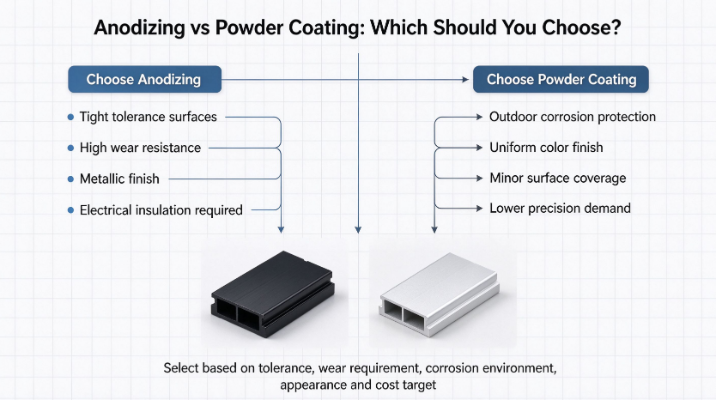
Choose anodizing when
- The surface must hold tight tolerances and the film thickness must stay small.
- Wear resistance is critical, particularly for sliding, rotating or repeatedly contacted surfaces.
- A metallic look is desired and the part is primarily indoor or protected.
- Surface electrical insulation is needed on mounting or mating features.
- Heavy friction or abrasive contact is expected, in which case hard anodizing is the appropriate specification.
Choose powder coating when
- Outdoor corrosion protection and long-term color uniformity are the top priorities.
- Aesthetic appearance and texture drive the design.
- Minor surface imperfections must be visually covered rather than revealed.
- Critical tolerances apply only to a few surfaces that can be masked, while the rest of the part can accept additional build.
Other options worth a brief mention
Electroless coatings, e-coat systems and PTFE-based dry films can also serve specific needs such as chemical resistance or low friction. They are usually selected for niche requirements rather than as general-purpose alternatives. Dual treatment, such as hard anodizing on functional faces combined with powder coating on exterior surfaces, is common in demanding automotive and robotics projects and often delivers the best overall balance.
Masking tip: Define masking zones on the drawing for threaded holes, sealing surfaces, ground contacts and press-fit diameters. Clear callouts prevent unplanned coating in areas that must remain bare or within a narrow dimensional band.
Common Mistakes Buyers Make
- Ignoring coating thickness in tolerance planning. The drawing shows bare dimensions, but the finished part has added film. Define whether dimensions apply before or after treatment.
- Specifying hard anodizing for cosmetic-only parts. Hard anodizing adds cost and process time without benefit when the part never sees wear or sliding contact.
- Using dyed anodizing for long-term outdoor exterior use. UV exposure can fade dyed films, which is a common issue on sunlit drone shells and automotive exterior components.
- Skipping proper pretreatment. Oils, oxides and handling residues reduce powder coating adhesion and affect anodic film uniformity, leading to peeling or patchy results.
- Failing to communicate masking requirements. Without clear instructions, threads may fill with coating and contact surfaces may lose conductivity or fit.
Avoiding these five errors often matters more than choosing the perfect finish, because most surface failures in precision aluminum parts come from communication gaps rather than from the chemistry itself.
Conclusion: Matching the Finish to the Job
There is no universal surface treatment for aluminum. Anodizing is the stronger option for precision functional performance, including tight tolerances, wear resistance and electrical insulation. Powder coating is the stronger option for robust corrosion protection, uniform color and visual coverage on exposed surfaces. In many real projects, the best result comes from combining both processes on different areas of the same part.
The most reliable approach is to define functional surfaces, tolerance-critical features, environmental exposure and appearance requirements before the process is chosen. Sharing drawings, tolerance callouts and working conditions with your manufacturer early allows the surface treatment to be planned alongside machining or forming. For projects built on cold forging aluminum components or precision machined housings, this early coordination is often the difference between a smooth launch and costly revisions.
Frequently Asked Questions
Q1: Does anodizing change the dimensions of an aluminum part?
Yes. Anodizing grows the oxide layer partly into the surface and partly outward, so dimensions change on both sides. Type II films are thin and usually have a small effect, while hard anodizing adds more growth. Drawings should specify whether dimensions apply before or after treatment and should compensate for film growth on critical features.
Q2: Is powder coating suitable for tight-tolerance aluminum parts?
It can be used, but only where the coating thickness is planned into the design or critical surfaces are masked. Powder coating adds a thicker film than anodizing, so it is generally better suited to housings, covers and frames than to precision bores, sealing faces or press-fit diameters.
Q3: Which finish is better for outdoor drone or automotive exterior parts?
Powder coating with an outdoor-rated resin system is usually the preferred choice for exposed exterior surfaces because it offers strong corrosion protection and good UV stability. Dyed anodizing is generally less suitable for long-term sunlit use, although sealed clear anodizing can perform well on some components.
Q4: When is hard anodizing worth the extra cost?
Hard anodizing is worth specifying when the surface experiences sliding contact, repeated friction, abrasion or high wear over its service life. For cosmetic parts or components that never contact other surfaces, Type II anodizing or powder coating is usually the more economical choice.
Q5: What information should I send to a manufacturer before choosing a surface treatment?
Share the drawings with tolerance callouts, a list of functional and cosmetic surfaces, the expected operating environment, the required service life, any electrical insulation or grounding needs, and the masking requirements for threads and contact areas. This information allows the manufacturer to recommend a finish and plan process steps accurately.

-
Tel Number
+86-0572-2210226Phone Number
+86-13819283977 +86-13655726561 +86-13567228000Address
Building B, Innovation and Entrepreneurship Industrial Park, No. 288, Yansan Road, Huzhou City, Zhejiang Province, ChinaQrCode
-
Quick Links
Home Products About Us Capabilities Industries News Contact Us -
Explore
Aluminum Camera Shell Of Vehicle Aluminium Cold Extrusion Aluminium Cold Forging Parts -
feel free to contact us
