

 English
  日本語
日本語  Deutsch

Industry News
 Oct 09, 2026
 Posted by Administrator
Cold Extrusion vs Die Casting Aluminum: Which Process Delivers Better Precision Parts?
Why Process Choice Shapes Precision Aluminum Parts
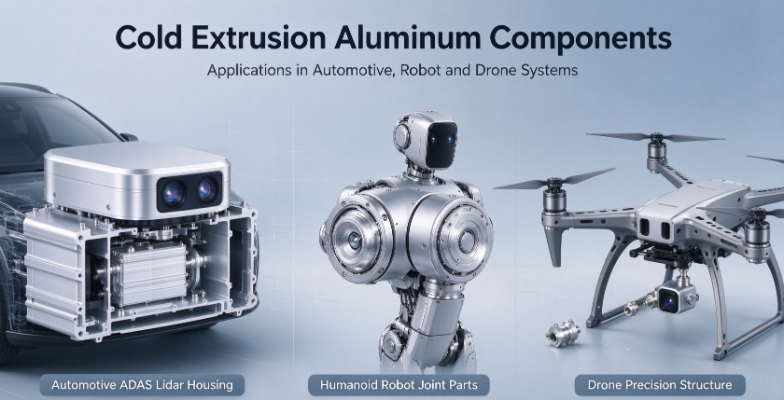
Engineers designing driver assistance sensors, lidar housings, humanoid robot joints, and drone structures face the same challenge. The aluminum component at the center of the system must hold tight dimensions, resist vibration for years, and behave identically from the first unit to the ten-thousandth. The manufacturing route chosen early in a project often decides whether those goals are reachable without costly redesign later.
Two processes dominate these discussions: traditional die casting and cold extrusion. Both can produce complex shapes in volume, yet they differ sharply in internal structure, mechanical performance, dimensional control, and the problems they create when pushed beyond their comfort zone. Buyers who treat them as interchangeable often discover the difference only after field failures or scrap appears on the production line.
This guide compares the two processes from an engineering and purchasing perspective. It explains how each one forms metal, where each performs best, what the cost picture really looks like, and how to write a specification that a capable supplier can meet. The trade-offs are presented openly, including the situations where die casting remains the smarter choice.
How Each Process Forms the Metal
The clearest way to understand the performance gap is to look at the physical state of the metal during forming. In die casting, aluminum is melted and forced into a steel mold under high pressure. In cold extrusion, a solid billet is pushed through a die at or near room temperature. That single difference shapes almost everything that follows.
Die Casting Aluminum
Molten aluminum fills the cavity quickly, which makes die casting efficient for complex thin-walled housings. The problem is what happens during filling and solidification. Air trapped in the melt and gases released as the metal cools form gas porosity, and shrinkage forms voids where thick sections freeze last. Even well-controlled processes leave some internal discontinuity, and those voids are most common in heavier sections of the part.
- Molten metal is injected into a steel die at high speed and pressure.
- The metal cools and solidifies, often in a few seconds for small parts.
- The casting is ejected and trimmed, then often machined on critical faces.
- Leak testing or inspection screens out parts with internal voids.
Cold Extrusion Aluminum
Cold extrusion works on solid material, so there is no liquid stage and no solidification shrinkage. The billet is compressed and forced through a shaped die, and the metal flows plastically to take the die form. This plastic flow tends to close internal discontinuities and aligns the grain structure along the direction of metal flow, which improves strength in the directions that matter most for loaded components.
- A cut billet of wrought aluminum is loaded into the press tooling.
- The press forces the billet through the die, shaping walls, bosses, and cavities.
- The formed part is trimmed and sometimes stress relieved or heat treated.
- CNC machining finishes only the features that need final accuracy.
Side by Side: Core Performance Differences
Procurement teams usually compare processes on five dimensions: structural density, strength and fatigue life, dimensional accuracy with surface finish, thermal behavior, and batch consistency. The table below summarizes typical outcomes. Actual results depend on alloy, geometry, tooling quality, and inspection standards.
| Criteria | Die Casting Aluminum | Cold Extrusion Aluminum |
|---|---|---|
| Internal structure | Gas porosity and shrinkage possible | Fully dense, closed discontinuities |
| Fatigue resistance | Moderate, sensitive to voids | High, suited to cyclic loads |
| Ductility | Often limited | Generally higher |
| As-formed surface roughness | Commonly around 1.6 to 3.2 micrometers Ra | Commonly around 0.8 to 1.6 micrometers Ra |
| Critical tolerance band | Often 0.1 mm or more without machining | Often 0.05 mm or better on formed features |
| Laser welding suitability | Limited by porosity | Strong, consistent weld results |
| Batch consistency | Varies with process drift | Stable over long runs |
Density and Pore-Free Performance
Density is the foundation for most other differences. Gas porosity in die castings is not always visible on the surface, which makes it a hidden risk. A housing can pass a visual check and still leak under pressure, or it can crack after a few thousand thermal cycles because a void sits near a load path. Cold extruded parts avoid the liquid-to-solid transition entirely, so these internal discontinuities are rare. That matters most for sealed sensor housings and any part that will be laser welded, because weld quality depends heavily on what lies beneath the surface.
Strength and Fatigue Resistance
Components in robot joints and vehicle chassis environments rarely fail from a single overload. They fail from millions of small stress reversals that slowly initiate cracks at weak points. Because cold extrusion produces a dense structure with directional grain flow, fatigue performance is generally stronger, especially at fillets, thin ribs, and bosses. Die castings can achieve excellent static strength, yet their lower ductility and sensitivity to internal voids can shorten fatigue life under vibration.
Dimensional Accuracy and Surface Quality
Die castings shrink as they cool, and tooling must compensate for that movement. Achieving tight tolerances usually means adding CNC machining to critical faces, bores, and mounting features. Cold extrusion forms parts closer to final dimensions and produces smoother surfaces, so fewer features need secondary machining. Fewer machining steps mean fewer handling events, less fixturing error, and better assembly fit.
Thermal Behavior and Batch Consistency
Thermal management is critical for lidar modules and sensor housings, where heat from electronics must reach the outer shell without creating hot spots. A dense, void-free wall conducts heat more predictably than a wall with scattered pores, which can interrupt heat flow unevenly. Over production runs, process drift in die casting can change porosity levels from shift to shift. Cold extrusion tends to hold steadier output, which reduces incoming inspection workload and helps defect rates stay low over time.
Visual Overview of the Two Production Routes
The diagram below shows the sequence of steps in each route. The key difference lies in the middle stage: liquid metal solidifies in one case, while solid billet flows plastically in the other.
Application Scenarios: Where Each Process Fits
Neither process is universally better. The right choice depends on the function of the part, the loads it carries, the sealing and welding requirements, and the production volume. The guidance below reflects common industry practice rather than a fixed rule, and engineering review should confirm each case.
Where Die Casting Remains a Sound Choice
- Low-precision housings where dimensional tolerance is generous and surface appearance matters more than internal integrity.
- Non-structural covers and shells that carry little load and do not require sealing under pressure.
- Very complex thin-walled geometry at high volume where tooling cost per part is the dominant driver.
- Projects where the design is still changing and fast tooling iterations matter more than long-term fatigue data.
Where Cold Extrusion Delivers Clear Advantages
- Lidar housings and automotive camera bodies that must stay sealed and dimensionally stable through temperature cycles.
- Humanoid robot structural parts that experience continuous reciprocating motion and must resist fatigue cracking.
- Drone components carrying high dynamic loads where weight and reliability both matter.
- Parts requiring laser welding or high airtightness, where a dense base material improves weld consistency.
Cost Picture: Unit Price Versus Total Cost
A common assumption holds that die casting is always cheaper. That is true for the unit price of a simple part in very high volume, but total cost includes scrap, rework, inspection, secondary machining, field returns, and the engineering time spent resolving quality issues. A lower quoted price can become the more expensive option once these hidden costs are counted.
Cold extrusion typically requires higher upfront tooling investment and a more careful billet and press setup. Its strength lies in yield and predictability. When fewer parts are rejected, fewer machining operations are needed, and output stays consistent across shifts, the cost per good part can compare favorably over the life of a program. Buyers should request total cost of ownership estimates rather than comparing unit quotes alone.
Design Tips for Specifying Aluminum Precision Parts
Whichever route you choose, a clear specification reduces risk. Drawings that describe function, not just geometry, help suppliers recommend the right process and flag problems early. Teams that work with a dependable cold extrusion aluminum parts supplier often gain the most from early design reviews.
- Identify which features carry load, seal, or conduct heat, and mark them as critical on the drawing.
- Specify wall thickness transitions gently to avoid stress concentration at sharp changes.
- Define surface roughness only where it matters, such as sealing faces and bearing seats.
- State the inspection method for internal integrity, such as leak testing or sectioning samples.
- Give the expected production volume and annual forecast so the supplier can plan tooling and capacity.
- Agree on a first article inspection plan and acceptance criteria before tooling is released.
Common Mistakes to Avoid
- Tightening every tolerance to the same value, which drives cost without improving function.
- Ignoring fatigue loads during design and checking only static strength.
- Leaving the process choice open without giving the supplier the performance requirements behind it.
What to Look for in a Precision Aluminum Supplier
Process knowledge is only part of the picture. A supplier producing precision aluminum components for demanding industries should be able to demonstrate control across the full chain from billet to finished part. The checklist below helps buyers evaluate capability before committing to a project.
- Experience with cold extrusion and CNC machining as an integrated workflow rather than separate subcontracted steps.
- Documented inspection capability, including dimensional measurement, surface checks, and internal integrity testing.
- Cleaning and surface treatment processes suitable for sealed or welded assemblies.
- Willingness to review drawings, suggest design adjustments, and support both custom OEM and ODM programs.
- Clear process control records that show how batch consistency is maintained over long production runs.
Conclusion: Matching the Process to the Performance Target
For precision parts that must stay dense, dimensionally stable, and fatigue resistant over long service lives, cold extrusion offers structural advantages that die casting struggles to match. Die casting still earns its place in simpler, lower-stress, high-volume applications where its speed and tooling economics make sense. The best decision starts with the function of the part rather than the process name.
If your next project involves sensor housings, robot structures, or drone components, share the drawings and performance requirements early. A detailed review of the geometry, loads, and sealing needs will show which route fits, and sample verification will confirm it before full production begins.
Frequently Asked Questions
Q1: Is cold extrusion always more expensive than die casting?
Not necessarily. Cold extrusion usually requires higher upfront tooling and setup costs, but it can lower total cost when fewer parts are scrapped, fewer machining steps are needed, and field returns decline. Comparing total cost of ownership gives a more accurate picture than comparing unit prices alone.
Q2: Can die cast aluminum parts be used in sealed or waterproof housings?
Yes, with proper design, process control, and leak testing. However, internal porosity in thicker sections can create leak paths that are hard to detect visually. For housings with strict sealing requirements, a dense base material often reduces this risk and improves consistency.
Q3: Why does fatigue resistance matter for robot and drone parts?
These parts see repeated loads during movement and vibration. Fatigue cracks usually start at small defects or stress concentrations and grow slowly over many cycles. A dense, directionally aligned grain structure helps delay crack initiation, which extends service life under continuous motion.
Q4: What tolerance can cold extrusion achieve on critical features?
On many formed features, tolerances around 0.05 mm or better are achievable, depending on geometry, material, and tooling condition. Final machining can refine features that need even tighter control. Early discussion with the supplier helps set realistic tolerances for each feature.
Q5: How do I decide which process to specify for a new design?
Start by listing the functional requirements: loads, sealing, welding, heat transfer, and expected volume. If the part is structural, sealed, or fatigue critical, cold extrusion deserves serious evaluation. If the part is simple, non-critical, and produced in very high volume with generous tolerances, die casting may be more economical. Sample testing on both routes can confirm the choice.

-
Tel Number
+86-0572-2210226Phone Number
+86-13819283977 +86-13655726561 +86-13567228000Address
Building B, Innovation and Entrepreneurship Industrial Park, No. 288, Yansan Road, Huzhou City, Zhejiang Province, ChinaQrCode
-
Quick Links
Home Products About Us Capabilities Industries News Contact Us -
Explore
Aluminum Camera Shell Of Vehicle Aluminium Cold Extrusion Aluminium Cold Forging Parts -
feel free to contact us
